
Substrate has a new mark. It is called Soma, and it replaces the layered strata mark we used until now. It is the logo on substrates.in, in browser tabs, and on home screens, and it will appear inside our products wherever the software needs to show what it is doing.
Why a cell body
A neuron receives signals through its dendrites. They converge on the soma, the cell body, where they are added together. If the combined input pushes the membrane past a threshold, the neuron fires; if it does not, the neuron stays quiet.
That is close to what our software does. It takes many partial signals, such as a report, a prescription, a lab value, or a note in someone's handwriting, and it should only say something when the evidence is sufficient. When it is not, the honest output is that it could not read a value reliably. We wanted a mark that is about that decision, rather than an abstract shape that could belong to any company.
Drawing it
The body is a slightly irregular outline, because cells are not circles. Fourteen dendrites leave it at uneven lengths. The face is two eyes and a mouth, the minimum needed to show attention, rest, or doubt. A small nucleus sits low on the right, and it is the only part of Soma's body that ever changes colour.
At small sizes the dendrites become noise, so below 48 pixels Soma is drawn without them. The compact drawing keeps the body and the face, which is what remains legible in a 16-pixel browser tab.
Compact
 16px
16px- 24px
- 32px
Full
- 64px
- 120px
- 200px
One state at a time
We drew Soma in thirteen states, and each one corresponds to something the software is actually doing: reading a document, comparing reports, saving a note, finishing a summary, failing to read a file. Soma always appears beside a sentence that says the same thing in words. It is never the only signal, so the interface still works for someone who cannot see it.
Writing the states this way forced a discipline on the copy as well. The thinking state never says "Thinking…"; the sentence beside it names the step, such as "Comparing reports…", because "thinking" describes nothing a reader can check. When something fails, the sorry state carries the apology, so the sentence beside it can stay plain and say what to do next.
Idle
The default, and the logo.

Hello
Upload a report to begin.

Happy
Changes saved.

Listening
Listening…

Recording
Recording · 00:42

Reading
Reading document…

Thinking
Comparing reports…
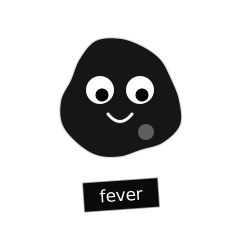
Carrying
Saving to Fever notes…

Done
Summary ready.

Unsure
We could not read this value. Check page 4.

Surprised
This file is larger than usual. It may take 3 minutes.

Sorry
We could not read this file. Try the original PDF.
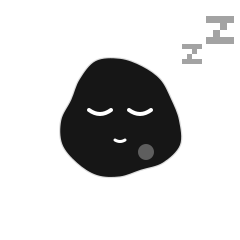
Sleeping
Processing resumes at 9:00.
Colour is reserved for the two cases where it carries information. The nucleus turns green only when a task has finished, and a red dot appears only while audio is being recorded. Every other state is grey, so a single glance at Soma answers whether the work is done and whether anything is listening.
At rest
Grey nucleus
Done
Green nucleus
Recording
Red dot
Printed in dots
Scientific illustrators have long drawn tissue by stippling, building tone from dots rather than lines, and laboratory instruments still print their readouts the same way. We adopted the rule that halftone printing uses: the grid is fixed, and tone comes from the size of each dot. There are five sizes, from faint grey to white, on an 8-pixel grid.
The homepage field and the footer are drawn this way. In the footer, our name is set in Geist Pixel Square and printed with one dot for each pixel of the typeface.
Motion is confined to these drawings. The text, buttons, and layout around them never animate, and if a device is set to reduce motion, each drawing renders as a single still frame.
A street at night drawn in dots, with a moon, buildings with lit windows, and trees shaped like neurons. Seven Somas are in it: one waving, one reading, one thinking, one listening, one asleep on a roof, one finished on another roof, and one carrying a note along the street.